-

-

Mail Us
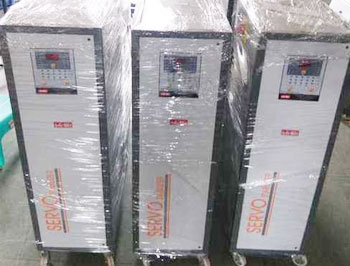
When the Servo stabilizer receives an input current, with fluctuating voltage, the microprocessors in the electronic circuitry triggers the Servo motor driver. This in turn activates the servo motor, which moves across the windings of the auto-transformer. As the servomotor's shaft is connected to the primary of the Buck Boost transformer, the movement automatically adjusts and increases or reduces the voltage value to the prescribed limit almost instantly. This adjustment of input voltage to the correct output voltage is the aim of the servo motor and the purpose of a servo stabilizer.
This controlled voltage is relayed through the secondary of Buck Boost transformer,and then fed to the appliance or machinery in use.
In 3-phase supply, the automatic voltage regular of Servo motor is coupled with 3 auto transformers and the process of voltage correction is carried out. Servo voltage stabilizer is the only stabilizer that can be used across single-phase and three-phase connections.
This is because there are various advantages of servo stabilizers over traditional relay type stabilizers. Some of them include high correctionspeed, accuracy upto +/- 1% tolerance value of voltage fluctuations, stable output, capability to withstand inrush current and durability. Periodic maintenance keeps the servo voltage stabilizer running for a very long time and proves to be a good investment in money on a long-term basis.